Vampire-Human Offspring
The Vampire Prince’s BrideVampire-Human Offspring are children born from the novel’s tightly controlled union between vampire men and human women. They are not simply biological hybrids or descendants in the background of the Fort’s society: their births sustain a vampire family line that cannot reproduce independently, determine where mothers and children may live, and expose the uneasy boundary between consent, captivity, transformation, and family. The birth of Charlotte, Lola and Valnoir’s daughter, gives this system its most concentrated and consequential example.
Definition and Reproductive Structure
Vampire-Human Offspring arise through a reproductive arrangement explicitly described as “Vampire man, human woman only.” At the Fort, this is not an incidental possibility but a social rule built into the community’s survival. The vampires require blood to live and are photosensitive, but their reproductive dependence on human women is presented as a separate biological necessity. Human women may be kidnapped and brought to the Fort, or may fall in love with vampires and move there willingly; in either case, pregnancy gives the relationship a recognized place within the Fort’s hierarchy.
The children themselves are said to grow up “all normal,” with a choice between staying at the Fort and leaving it. That choice is formally available, but it is not socially neutral: remaining is encouraged and preferred, while departure is looked down upon. The child therefore inherits more than a mixed parentage. The child inherits a disputed membership in the vampire household, a family expectation, and the pressure to continue the community’s way of life without necessarily becoming a vampire.
The Fort’s Family Line
The Fort provides the clearest institutional setting for Vampire-Human Offspring. It is an eighteenth-century mansion containing more than 500 rooms across roughly ten stories, with most of its space underground and additional rooms continually dug as more vampires join the community. More than 300 people live there, receive work assignments, and participate in a system that presents collective labor as necessary to survival. Within that extensive household, children born to human women connect the present community to its vampire families without requiring every new member to be transformed.
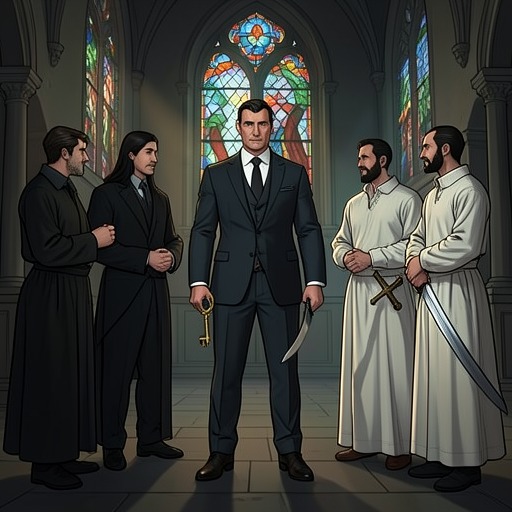
Valnoir’s account traces the Fort’s established family line back to the Great Plague, when Viktor bit and transformed Valnoir, Magnus, Charlotte, Victoria, Lady Harriet, and Lady Mary. This history shows the difference between vampiric transformation and Vampire-Human Offspring. Viktor created vampires through biting, whereas the Fort’s later human mothers give birth to children who remain physically and socially distinct from the undead adults around them. The household thus reproduces itself by two different means: supernatural conversion for vampires and human pregnancy for the next generation.
The Fort’s organization also reveals the practical consequences of this arrangement. Pregnant women move to other floors, where they may live as humans or vampires according to their own choice, and their children are raised within the larger community. Reproduction is therefore tied to housing, labor, family status, and the Fort’s attempt to maintain a normal appearance. The family line is preserved not in a private domestic sphere but through a communal institution whose rules reach into the bodies and futures of both mothers and children.
Charlotte’s Birth and Lola’s Transformation
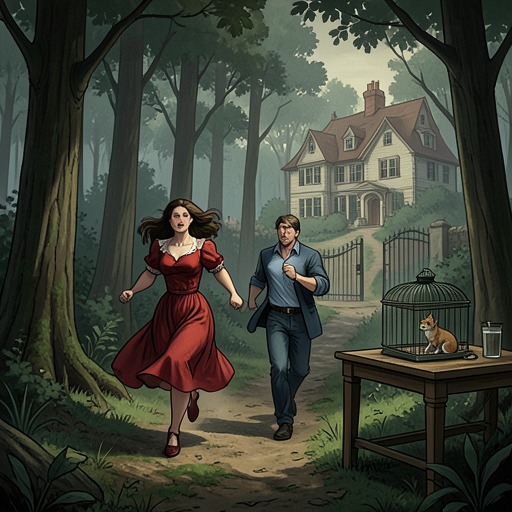
Charlotte’s birth is the novel’s most developed instance of Vampire-Human Offspring. After Valnoir has drugged Lola and brought her to the Fort, he initially confines her in the Harem, a basement space associated with sexual relationships and the movement of women through the Fort. Lola understands that some human women there were forced into the community, while others entered willingly, and that pregnancy changes their living arrangements. Her captivity therefore becomes entangled with the same reproductive system that the Fort presents as ordinary and sustainable.
Lola’s pregnancy also changes Valnoir’s conduct. When she asks whether he has turned her into a vampire, he answers that he has not because doing so would kill their child. The statement establishes a biological limit with immediate emotional force: the unborn child’s survival prevents Lola’s transformation while she is pregnant. It also marks the child as “our child” in Valnoir’s language, shifting the pregnancy from an imposed condition within the Fort to the basis of a claimed family bond.
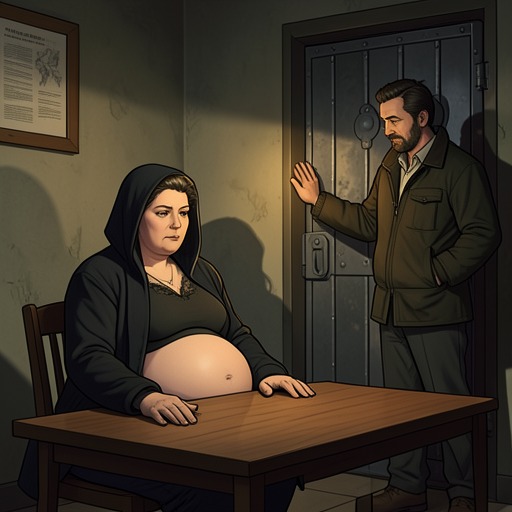
During labor, Lola gives birth to a girl. The scene initially appears to end in death: the baby cries while the adults stand around Lola’s body, and no sign of life can be found. Valnoir then reveals that he turned Lola while she was dying, allowing her to return as a vampire after the delivery. Charlotte’s birth therefore produces two linked changes. A human woman becomes a vampire only after the child is safely born, and a new Vampire-Human Offspring enters the Fort’s family line without being transformed herself.
The naming of the child completes the scene’s movement from crisis to family formation. When Victoria asks what name has been chosen, Lola and Valnoir answer together: “Charlotte.” The name repeats that of Valnoir’s four-year-old sister, whom Viktor transformed during the Great Plague, linking the newborn to the older vampire family while preserving the distinction between inherited family identity and biological condition. The child’s arrival is consequently both a birth and a renewal of the Fort’s lineage.
Consent, Captivity, and Medical Power
The concept also intersects with the novel’s wider concern with who controls reproductive bodies. Valnoir admits that he did not plan to kidnap Lola, but he drugged her, brought her to the Fort, and prevented her from leaving after she wanted to go. He insists that the Harem is not a brothel and that women are protected from physical abuse there, yet Lola remains locked in the basement and lacks the magical knowledge or ingredients needed to escape safely. The distinction between formal protection and actual freedom is therefore central to the reproductive system.
The same tension appears elsewhere in the book’s cross-species pregnancies. Lisa is initially told that a lifeform is attached to her uterine wall and feeding on her, before a deeper scan identifies an embryo. The medical technology can distinguish parasite from pregnancy, but the scene makes the pregnant body a site of uncertainty, surveillance, and intervention. Gemma’s pregnancy with Shay’s child receives an even more direct political interpretation: the Science Board declares that the child could be the key to curing the Stlozyn disease and demands access to research that would endanger Gemma and the fetus. Shay refuses because extracting fetal DNA without meaningful consent would be unethical.
These parallel cases place Vampire-Human Offspring within a larger pattern of reproductive politics. A pregnancy may be treated as a family’s future, a community’s biological resource, or a scientific specimen. The mother bears the immediate physical risk, while institutions and male partners claim authority over the child’s meaning. Yet the novel also gives mothers and partners moments of resistance: Shay protects Gemma and their child from the Science Board, while Lola’s survival and later response to Valnoir complicate the coercive circumstances of her pregnancy.
Narrative Significance
Vampire-Human Offspring reconcile two apparently opposed conditions: the vampires’ undead existence and the human body’s capacity to give birth. They are evidence that the Fort is not merely a refuge for transformed immortals but a reproductive society with a future beyond its original eighteenth-century generation. Their existence also preserves a category of choice that full vampiric transformation removes. A child may grow up among vampires, remain human, become part of the community, or leave it, although the Fort’s preferences make that freedom socially pressured rather than absolute.
Charlotte’s birth makes the concept emotionally legible. The child is protected from vampiric transformation before birth, becomes the reason Lola remains human during pregnancy, and then becomes the reason Valnoir turns Lola only when she is dying. The newborn’s arrival is followed by Lola’s return from death, Valnoir’s declaration of love, and the parents’ shared choice of a name. The result is not a simple resolution of the Fort’s coercive reproductive order. It is a family formed inside that order, carrying both its violence and its possibility of attachment.
Through Vampire-Human Offspring, the novel repeatedly unsettles the borders between human and vampire, natural birth and supernatural transformation, biological inheritance and chosen belonging. Human mothers are treated as necessary to vampire continuity, but the children born from them are not reduced to reproductive instruments. They become the living link through which the Fort imagines survival, inheritance, and a future that is neither wholly human nor wholly undead.